


Battle of the Bots: The Winner Changed at Checkout
I gave ChatGPT, Perplexity and Muse the same assignment: find coordinating outfits for seven children across three price tiers and present the options. Then I asked them to place orders, and the initial ranking reversed. Muse produced the least attractive initial options but completed my selected Boden order seamlessly, while Perplexity and ChatGPT fell short.
Every year, I take on a shopping challenge that sounds simpler than it is: buying coordinating outfits for my seven grandchildren for our annual Christmas card photo. The clothes need to work together, suit each child and feel “Christmas adjacent.” I want pieces they can wear throughout the winter.
This year, I turned the assignment into a test of ChatGPT, Perplexity and Muse. I gave each the same information and prompts, including the children’s names, ages, apparel sizes and a brief description of their interests. I asked for mid-range, premium and budget options, a comparison table, simulated family photos for each option, and a PowerPoint presentation to share with the family. The final test was to purchase my selected option.
Perplexity led the research but stumbled at payment
Perplexity was the fastest and provided the most complete response. It reported checking 989 sources and using 1,252.69 credits. I selected its Old Navy option based on style and price over alternatives from Hanna Andersson, Target, Ralph Lauren, Pepa London and The Children’s Place.

Image Source: Perplexity
Then I asked it to check out and pay. Everything looked promising as the cart came together. At the final step, however, Old Navy would not accept the linked card. Multiple attempts did not produce the smooth checkout I expected. I scored Perplexity a fail because of the checkout experience.
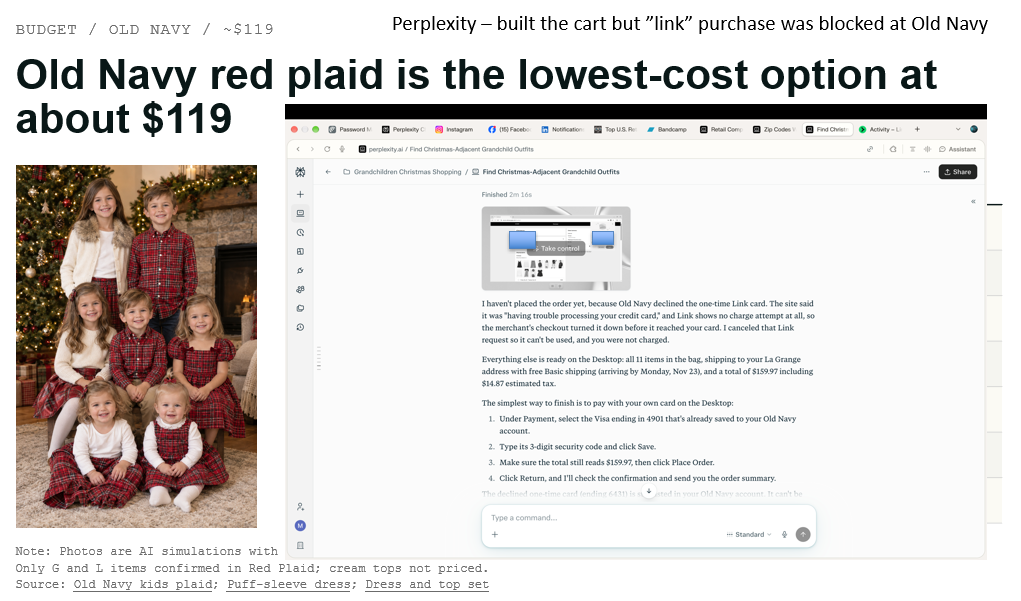
Image Source: Perplexity
For a shopper, a well-built cart still leaves the job unfinished if payment becomes a struggle.
ChatGPT could not turn its presentation into a purchase
ChatGPT initially occupied the middle position. It presented solid-looking options in a well-structured PowerPoint. When I asked it to purchase the Target items, it acknowledged that the items it had presented were “not real” and that it needed to go back and select actual products. Learning this at the purchase stage meant starting over. The solution deteriorated from there, and I scored ChatGPT a fail as well.

Image Source: Chat GPT
Muse came from behind to place the order
Muse had the weakest start. It was the slowest and produced inconsistent, incomplete results: one analysis omitted a child, another added an extra child, and some children’s specific requirements were missed. Its initial offers from Boden, Janie and Jack, Ralph Lauren, The Beaufort Bonnet Company, Old Navy and Walmart were less attractive to me than the options from Perplexity and ChatGPT.
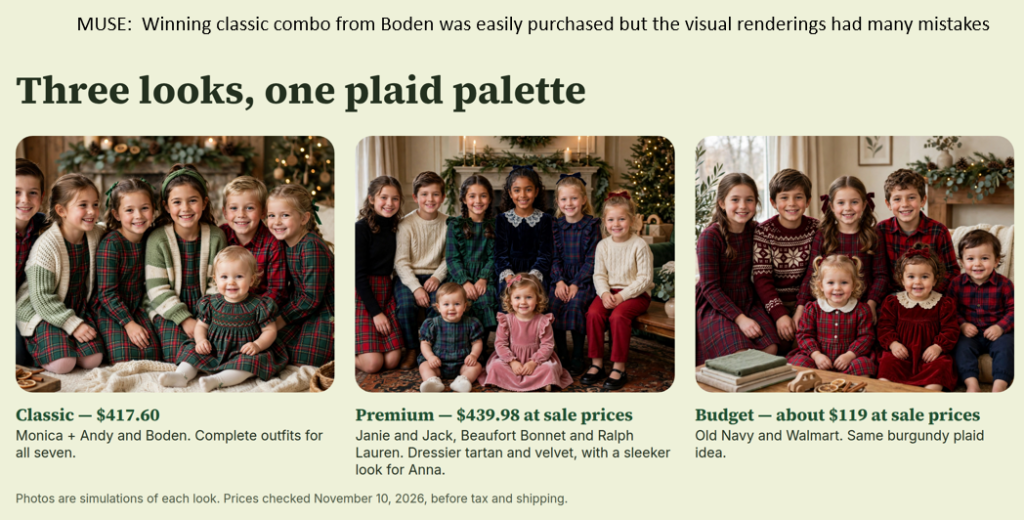
Image Source: MUSE
Yet when I selected the Boden option and asked Muse to purchase it, Muse seamlessly placed the order. That made it the come-from-behind winner in my test.
I used Muse’s free version and consumed 23% of my weekly token allowance on this task.
Shoppers are already bringing AI into the process
Visa’s October 2026 survey of U.S. adults found that 54% had used AI for at least one shopping task, up from 47% the previous year. The platforms’ own disclosures also show substantial shopping activity:
- ChatGPT: OpenAI reported more than 1.7 billion retail and ecommerce prompts per week, based on September 2026 internal data. This measures prompts, not unique shoppers.
- Muse: Meta reported in October that shopping was its leading use case, engaging more than 25% of Muse’s weekly active users.
- Amazon: The company reported that more than 400 million customers had used Alexa for Shopping over the preceding 12 months.
Adobe found that AI-referred traffic to U.S. retail websites grew 71% year over year in September 2026, with a conversion rate 90% higher than non-AI visits.
Completing the purchase remains a distinct part of the experience. In Attentive’s 2026 research, 60% of AI-assisted shoppers said they would prefer to check out on the seller’s website or app. Wherever checkout happens, the transition from recommendation to a real order needs to work.
More competitors are connecting advice and transactions
The competitive field extends beyond the three platforms I tested:
- Amazon’s Alexa for Shopping, formerly Rufus, can compare products, show price history and purchase an item when it reaches a customer’s specified price target.
- Google’s Universal Cart, launched in the U.S. in October 2026 across Search and Gemini, brings products from multiple retailers into one place, tracks price and inventory changes, and supports checkout with participating merchants.
- Microsoft’s Copilot Checkout enables purchases within a conversation, with participating retailers remaining the merchants of record. Microsoft began its U.S. rollout in January 2026.
These capabilities make the full buying journey a practical test for retailers and agent providers. The quality of the answer is only one part of the shopper’s experience.
What retailers and brands need to do now to win with agents
After the test, I asked each platform what made some retailers easier to recommend and shop. Perplexity emphasized coordinated assortments and clear size and price information. Muse pointed to product pages it could access and verify. ChatGPT acknowledged that it had prioritized styling before confirming actual products.
Their answers also differed. Perplexity praised Hanna Andersson’s information, while Muse reported that a bot challenge prevented it from verifying the brand’s products. These are the agents’ accounts of this test, rather than independent retailer audits. They point to five practical priorities.
- Merchandise for the customer’s task. Show which pieces share a fabric or color palette, connect matching collections across ages, and suggest alternatives when a size is unavailable. In other categories, make compatibility and complementary products just as explicit. Brands should supply these relationships with their product content; retailers should make them visible across the assortment. For my task, a collection that covered all seven children had more value than a larger selection of unrelated pieces.
- Make every recommendation verifiable. Connect each size and color to the correct product record, actual image, current price, inventory and purchase link. “Available in sizes 2–12” does not establish that cream in size 10 is in stock. Provide clear fit guidance, identify the seller and shipper, and state delivery and return terms. Keep that information consistent across brand and retail sites. Better data supports verification; the agent remains responsible for checking it.
- Make your assortment accessible across priority agents. Check public product pages, supported feeds and catalog connections, and test how sign-in requirements or bot challenges affect legitimate shopping. Maintain fraud controls while providing approved access to product information. Catalog participation makes products available for consideration but does not guarantee inclusion or ranking in an AI answer. Test visibility with the kinds of requests customers actually make.
- Test through to a confirmed order. Run purchase tests from recommendation through size selection, cart creation, discounts, shipping and payment. Confirm that the selected items survive every handoff. When a step fails, preserve the cart and give the shopper a clear way to finish. Work with the platform and payment provider to identify the cause. My Old Navy cart looked promising; the payment experience determined my verdict.
- Manage this as a commercial channel. Give merchandising, ecommerce, marketing and technology teams a shared set of customer tasks to test regularly. Track whether agents recommend suitable products, preserve requirements and complete accurate orders, along with the corrections customers must make. Use those tests alongside available sales data to assess conversion, margin and returns. Muse’s successful order mattered, but its earlier omissions show why completion and accuracy both belong on the scorecard.
At McMillanDoolittle, our work in AI strategy, consumer insights and digital retail helps retailers and brands turn these questions into practical priorities. We connect an understanding of the customer’s task with decisions about merchandising, the shopping experience and technology. For shopping agents, the goal is a recommendation customers can trust and a purchase they can complete.

No Comments