


Tokyo Retail Through the Lens of New and Old
I lived in Tokyo in my 20s, and relish every moment on a return trip – personally and professionally to study retail as part of our bi-annual EbeltoftGroup partners’ meetings. Observations over 3 days of touring this great retail city brings a familiar Japanese-tension between change and permanence. Buildings disappear, brands arrive, and retail formats evolve, yet neighborhoods retain a character that feels remarkably durable. Our Tokyo Retail Study Tour offered a chance to explore that juxtaposition: how a city so enthusiastic about new continues to draw strength from longstanding habits, traditions and expectations.
Daikanyama and Ginza neighborhoods make an appealing comparison. Daikanyama wears its trendiness with an apparent ease, inviting discovery through boutiques, cafés and carefully considered lifestyle retail. You’re compelled to linger longer because a new discovery is around the corner. Ginza projects the confidence of “old money,” with established prestige and polished storefronts. Multi-generation sweet shops evoke a different era, scattered among flagship experiences of global brands. Tokyo rewards anyone willing to look beyond a neighborhood’s reputation to find surprise and delight moments.

Image Source: McMillanDoolittle
In Ginza, UNIQLO turns everyday clothing into a flagship experience, while DAISO and its sister brands bring accessible design into a district associated with luxury. Daikanyama’s contemporary appeal, meanwhile, rests partly on enduring pleasures: browsing books and art, finding something unexpected and spending time somewhere thoughtfully designed. There is always another layer, and shopping in Tokyo provides constant reminders of great retail.
Four examples illustrate what retailers can learn:
- Starbucks Roastery: belonging in the neighborhood. In Nakameguro, close to the buzz of Shibuya, Starbucks Reserve Roastery demonstrates how a global brand can respond to an upscale neighborhood’s character. Kengo Kuma’s cedar-clad, layered terraces connect the building to the Meguro River and its cherry trees. That relationship helps explain why such a substantial destination feels appropriate here and does not overwhelm its neighbors. The lesson is to give customers an experience that draws meaning from its surroundings.

Image Source: McMillanDoolittle
- Ekiben and travel retail: convenience with style. Tokyo Station’s GRANSTA and Ekibenya Matsuri show how much care can fit into a hurried purchase. Regional bento assortments turn a meal for the train into an act of discovery. We were thrilled to shop for our Shinkansen bento, and admire the efficient store operations at scale. Any retailer serving busy customers can learn from this combination: make the transaction easy while preserving the pleasure of the purchase.
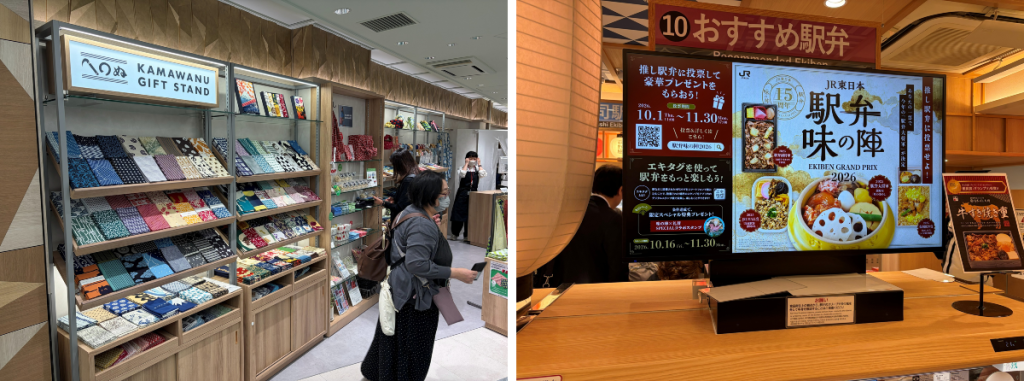
Image Source: McMillanDoolittle
- FamilyMart and Famima: expanding brand affinity. FAMIMA PARK Azabudai pushes beyond the familiar convenience-store mission. Convenience Wear, exclusive merchandise and spaces designed for discovery give customers additional reasons to engage with this iconic “Konbini” brand. The interesting question is how far brand affection for an everyday retailer can travel. We admire the strategic bet, “raising the bar” on private label, and earning a place in shoppers’ wardrobe and leisure time. We’re curious what next steps for Famima will be and we’ll monitor progress. Bonus points if you can relate to my exciting purchase of a “Famchiki” keychain.

Image Source: McMillanDoolittle
- Tsutaya Books: curation that keeps changing. We visited Tsutaya Books’ Daikanyama and Ginza Six locations and loved both. They use popups to introduce independent creators, artists and brands alongside its core, curated offer of books and gifts. Programming includes art and music collaborations, inviting spaces, and creating fresh connections for visitors to explore. Retailers can apply that principle through local popups: choose contributors who deepen the store’s point of view and give regular customers something new to discover.

Image Source: McMillanDoolittle
Across these experiences, one constant deserves as much attention as the concepts themselves: service standards in Japan are outstanding. The care taken with an ordinary transaction, the handling of a purchase and the attention to detail create expectations that are difficult to replicate outside Japan. They underlie almost every retail experience as a customer, quietly connecting Tokyo’s newest retail innovation with its most enduring traditions.
Traveling to a new city and looking for the best retail experiences? Contact us for insights – if we haven’t been there one of our global colleagues have!

No Comments