

Upper Bound 2026: AI Agents, Retail, and the Next Competitive Advantage for Retailers and Brands
AI agents are quickly moving from experimental pilots to practical tools that can reshape customer experience, merchandising, operations, and commerce. The retailers and brands that win will be those that solve real business problems, build strong data foundations, govern AI responsibly, and prepare for a future where shopping decisions may be influenced by autonomous agents. But, Real-world, value-add AI execution is hard. Across retail and consumer products, executives are inundated with the promises of AI: smart shopping assistants, autonomous agents, personalized recommendations, inventory optimization, and predictive merchandising. Yet the reality inside most organizations is far more complex. Success isn’t determined by the sophistication of technology alone. It depends on data quality, governance, organizational readiness, and a clear understanding of where AI creates measurable business value.
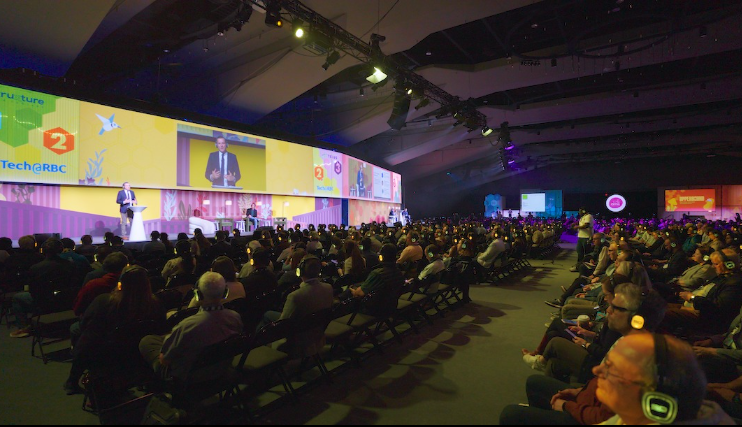
These themes took center stage at Upper Bound 2026, one of North America’s largest AI conferences, held May 19–22 in Edmonton, Alberta. The event brought together more than 10,000 attendees, 250 speakers, and over 200 sessions focused on the future of artificial intelligence, machine learning, and emerging technologies.
Among the featured speakers was Mary Purk, Partner Affiliate and AI Advisor with McMillanDoolittle, a retailer and consumer services firm. She joined a distinguished panel of retail and e-commerce experts, to explore the industry’s most pressing questions: How do organizations move beyond AI experimentation and build systems that actually work? The session, AI and the Agent Economy, challenged the hype surrounding AI agents and focused instead on practical application. The discussion examined how retailers are deploying AI to reduce customer friction, improve merchandising decisions, optimize operations, and create more personalized shopping experiences—all while maintaining the human expertise that remains essential for creativity, judgment, and innovation.

Image Source: Customer Maps YouTube
The Gap Between AI Pilots and Real Deployment
One of the strongest themes from the discussion was the difference between an impressive AI pilot or demo and a true operational solution. Many AI initiatives still live in the demo phase. They may look compelling in a controlled environment, but they do not always solve a clear business problem, scale reliably, or integrate into the way teams actually work. A successful AI implementation does more than showcase technical capability. It must engage customers effectively, deliver measurable value, operate consistently at scale, and connect with existing business processes.
The panel emphasized that the hardest part is often not the AI model itself. It is the orchestration layer: deciding when AI should act independently, when it should ask for more information, and when it should escalate to a human. The key lesson is that AI implementation is not a one-time launch. It is an iterative process of testing, learning, refining, and improving. “If you can turn the AI off and nothing breaks, you still have a demo.”
AI Agents: Who Are They Really Working For?
A major strategic question emerged around AI agents: who do they serve?
There are two very different models beginning to take shape.
Platform-Controlled Agents
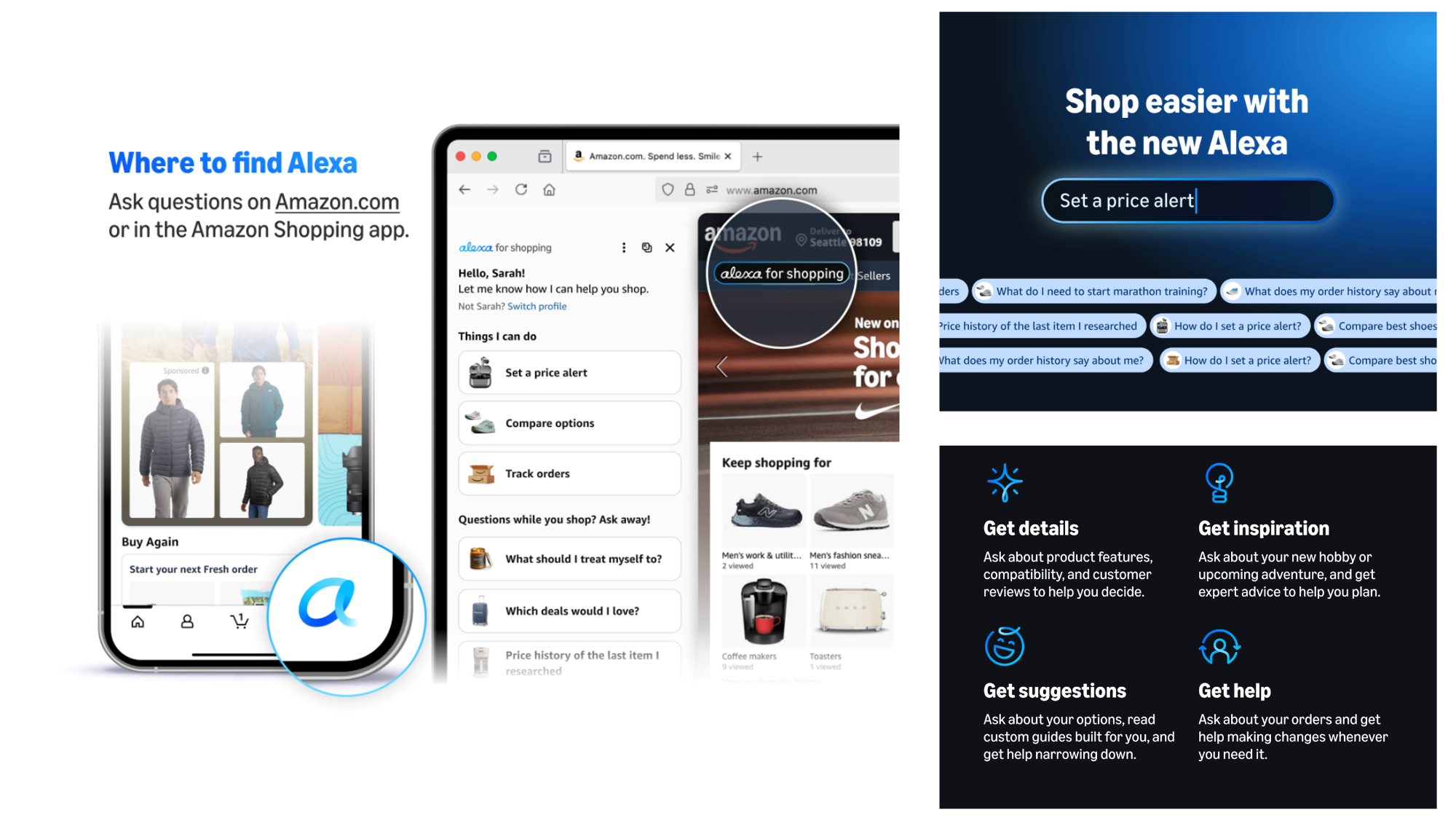
Image Source: Amazon
Examples include Amazon Alexa Shopping, Walmart’s emerging shopping assistants, and other commerce tools embedded within large retail ecosystems. These agents may be helpful to the customer, but they are also designed to optimize for the platform’s business model, assortment, advertising ecosystem, and transaction flow. For brands, this raises an important question: how do you maintain visibility when a platform-controlled agent is influencing what customers see, compare, and buy?

Image Source: Walmart
Consumer-Controlled Agents
The panel also discussed a future where personal AI agents work directly on behalf of the consumer. These agents compare retailers, evaluate alternatives, negotiate pricing, assess reviews, monitor availability, and prioritize the customer’s own preferences. That shift will fundamentally change how brands compete. Instead of optimizing only for human shoppers, brands need to optimize for machine-readable decision-making systems. The strategic implication is significant: retailers and brands need to understand whether future shopping decisions will be shaped by platforms, consumers, or some combination of both. The biggest question may not be, “Which AI tool should we buy?” It may be, “Who controls the AI agent that our customer uses to make purchasing decisions?”
AI’s Best Job Is Reducing Friction
Ms. Purk returned to a simple but powerful idea: AI should not be treated primarily as a technology initiative. It should be viewed as a friction-reduction tool. In retail, friction shows up everywhere. Customers struggle to find the right size, determine whether inventory is available, compare products, understand delivery options, initiate returns, or feel confident in a purchase decision. AI can help when it makes those moments easier. Mary discussed examples, including Ralph Lauren’s “Ask Ralph” assistant which provides inventory-aware recommendations, personalized styling assistance, store-specific product lookup, and automated fulfillment guidance. The strongest AI experiences share a common purpose. They save time, simplify decisions, reduce effort, and increase customer confidence.
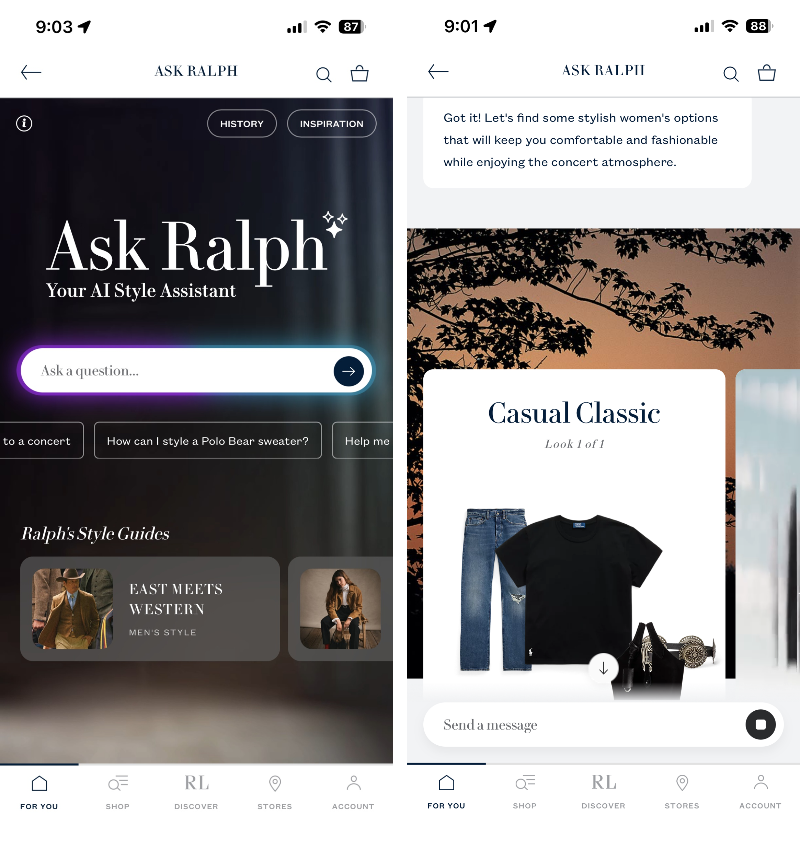
Image Source: Ralph Lauren
Data Is the Foundation of Agentic Commerce
The panel repeatedly returned to one foundational truth: bad data leads to bad AI. For AI agents to function effectively, organizations need accurate product information, reliable inventory visibility, consistent pricing, quality reviews, and strong customer data governance. Without those basics, even the most sophisticated AI tools will struggle to deliver useful outcomes. This is especially important for small and mid-sized brands. Their challenge may not be product quality. It may be discoverability.
In an agent-driven commerce environment, structured product data becomes critical. AI agents rely on attributes, availability, reviews, specifications, compatibility, pricing, and other machine-readable signals. Traditional marketing copy alone will not be enough. Brands with incomplete, inconsistent, or poorly structured product data risk becoming invisible to AI-driven recommendation engines.
Start Small, Especially for Small and Mid-Sized Retailers
The panel strongly advised against launching broad, enterprise-wide AI transformations too early.
For many retailers, the smarter approach is to start with one clearly defined use case. That could be order tracking, customer service, internal knowledge support, product recommendations, product content generation, or store associate assistance. Starting small creates several advantages. Implementation is faster. Risk is lower. Success is easier to measure. Teams learn more quickly. And the organization begins to build the muscle needed for larger AI adoption later.
The idea of being a “fast follower” came up repeatedly. Smaller retailers do not need to absorb the cost and complexity of being first movers in every area. They can learn from larger retailers’ successes and mistakes, then apply AI in focused, practical ways.
Governance Is No Longer Optional
Another clear warning from the panel was that AI governance needs to develop alongside AI adoption, not after it. Retailers and brands should establish AI governance committees, define which tools are approved, implement evaluation frameworks, and train employees on responsible AI usage. Teams also need clear guidance on what data can and cannot be entered into public AI tools. This is a particularly urgent issue as employees experiment with consumer-grade AI platforms. Without controls, sensitive company information, customer data, pricing strategy, product plans, or proprietary content could be exposed. Enterprise-grade AI environments and internal policies are becoming essential. Governance is not about slowing innovation. It is about making innovation scalable, secure, and trustworthy.
AI and the Workforce: Augmentation, Not Just Replacement
The discussion also challenged the idea that AI’s primary impact will be job replacement.
A more productive frame is augmentation. AI can automate repetitive work, allowing employees to move into higher-value activities that require judgment, empathy, creativity, and relationship-building.
Mary highlighted IKEA’s reskilling of thousands of call-center employees into customer-facing design advisor roles as one example of how automation and workforce development can work together.
For retailers, the opportunity is not simply to remove labor from the system. It is to redesign work so that employees are spending less time on repetitive tasks and more time on activities that improve the customer experience and strengthen the brand.
Where AI Agents May Become Autonomous First
The panel identified several areas where AI is likely to become more agent-driven over the next two to three years. In customer operations, this includes customer service, order tracking, FAQ management, and returns processing. These tasks are often repetitive, high-volume, and governed by clear rules.
In merchandising and inventory, AI agents could increasingly support replenishment decisions, allocation optimization, demand forecasting, pricing recommendations, and markdown optimization.
In marketing and content, AI is already playing a larger role in product content generation, search optimization, product attribute management, analytics, and reporting. The strongest candidates for AI autonomy are tasks that are repetitive, data-intensive, rule-based, and high-volume. These are areas where AI can increase speed and consistency while freeing teams to focus on more strategic decisions.
AI Will Make Merchants Faster, Not Obsolete
The merchandising conversation was especially relevant for retail leaders. AI is highly effective at data analysis, scenario modeling, forecasting, inventory optimization, and trend detection. It can process enormous volumes of information and identify patterns faster than any human team. But human merchants still hold critical advantages. They bring creativity, cultural interpretation, trend intuition, product vision, and brand storytelling. Fashion merchandising offered a useful example. AI may detect rising demand signals, but a merchant can understand why a color like “butter yellow” suddenly resonates culturally, even if historical sales of yellow products were weak. The consensus was clear: AI is not replacing merchants. It is making merchants faster, better informed, and more effective.
Retail Needs New KPIs for an AI-Enabled Future
Several panelists argued that traditional retail metrics may unintentionally discourage innovation.
Most organizations still reward sales growth, margin, inventory turns, and operational efficiency. Those metrics remain important, but they may not fully capture the value of experimentation, trend identification, innovation, and test-and-learn initiatives.
If teams are only measured on near-term performance, they may avoid the experimentation required to learn how AI can create value.
Future-ready organizations may need to expand their KPI frameworks to reward smart experimentation, speed of learning, and the ability to identify emerging opportunities before they are obvious in the data.
Final Strategic Takeaways for Retailers and Brands
The panel closed with several practical recommendations:
- Start with one problem. Avoid trying to transform the entire enterprise at once. Pick a measurable use case and prove value.
- Build strong data foundations. Structured, accurate, and accessible data is becoming a competitive necessity.
- Keep humans in the loop. AI should augment expertise, not replace judgment.
- Invest in governance early. AI policies, controls, approved tools, and evaluation processes are now essential.
- Prepare for agentic commerce. The rise of AI agents may change how shoppers discover products, compare options, and make decisions. Retailers and brands need to understand how they will remain visible and relevant in that environment.
“The brands most at risk are not the ones that tried the wrong thing. They’re the ones that waited for clarity.”
What This Means for Retail Leaders
AI is moving quickly, but the path forward does not require chasing every new tool. The most successful retailers and brands will focus on practical use cases, clean data, thoughtful governance, and customer experiences where AI clearly reduces friction.
At McMillanDoolittle, we help retailers, brands, and technology partners evaluate where innovation can create real business impact. From customer experience strategy and merchandising transformation to store operations, digital commerce, and emerging retail technology, our team can help organizations identify the right AI opportunities, prioritize investments, and build practical roadmaps for the future of commerce.

No Comments