


Luxury Grocery Goes Coast to Coast
Luxury grocery is emerging as one of the most attention-grabbing new frontiers in food retail. While Erewhon may have defined the modern luxury grocery playbook, the concept is no longer confined to Los Angeles and is increasingly taking shape as a coast-to-coast retail trend. Over the past several months, three buzzy concepts—Laurel Supply in West Hollywood, Meadow Lane in Tribeca, and Nude Miami in Brickell—have either opened or are preparing to, and all have already drawn comparisons to Erewhon, the celebrity-favored Los Angeles grocer that helped turn organic shopping, wellness products, and a $24 smoothie into a lifestyle statement. What is spreading is a more curated, design-forward, social-media-ready version of premium grocery.

Image Source: McMillanDoolittle
Laurel Supply brings “quiet luxury” grocery to West Hollywood
Laurel Supply opened earlier this month at 8445 Santa Monica Boulevard in West Hollywood, less than half a mile from the nearest Erewhon. The 17,000-square-foot store comes from Dean McKillen and Phil Howard, the team behind Laurel Hardware and Laurel Grill, and it launched with almost no traditional marketing: no press release, no major social rollout, and not even a website. Inside, the store leans heavily into natural light, high ceilings, pale wood, and a polished, almost hospitality-like atmosphere.
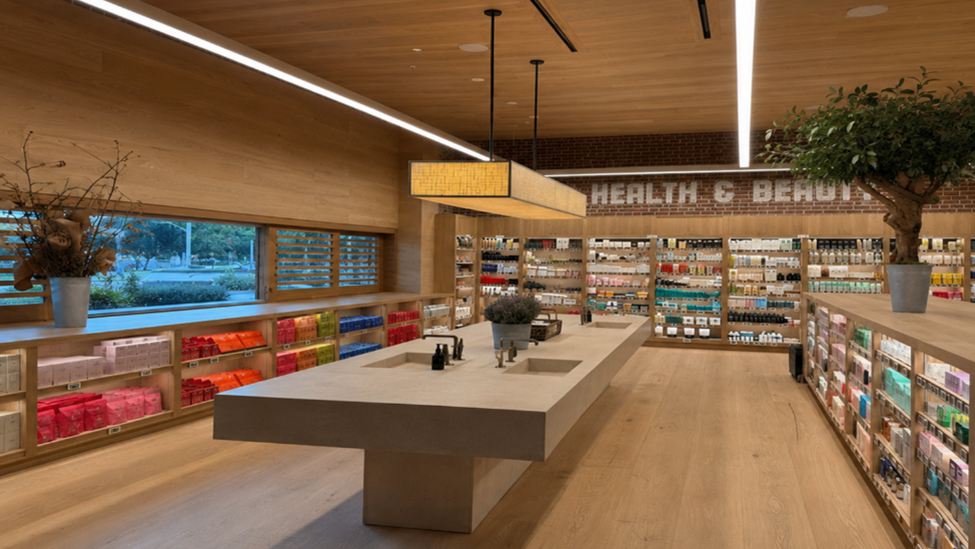
Image Source: McMillanDoolittle
The assortment is broad, but the foodservice is what really stands out. Laurel Supply blends grocery with prepared foods and café culture, offering an organic butcher counter, sushi, hot and cold bars, rotisserie chicken, gelato, bakery items, and a smoothie, juice, coffee, and matcha bar. A domed pizza oven turns out blistered pies and slices, and the store even features an in-house flour mill. Price-wise, it is very much playing in the luxury lane: shoppers have already noticed items like $17 tortilla chips, $20 organic yogurt-covered raisins by the pound, $14 to $16 smoothies, and even a $350 fragrance in the apothecary section. The result feels less like a traditional grocer than a wellness-minded food hall with groceries attached.
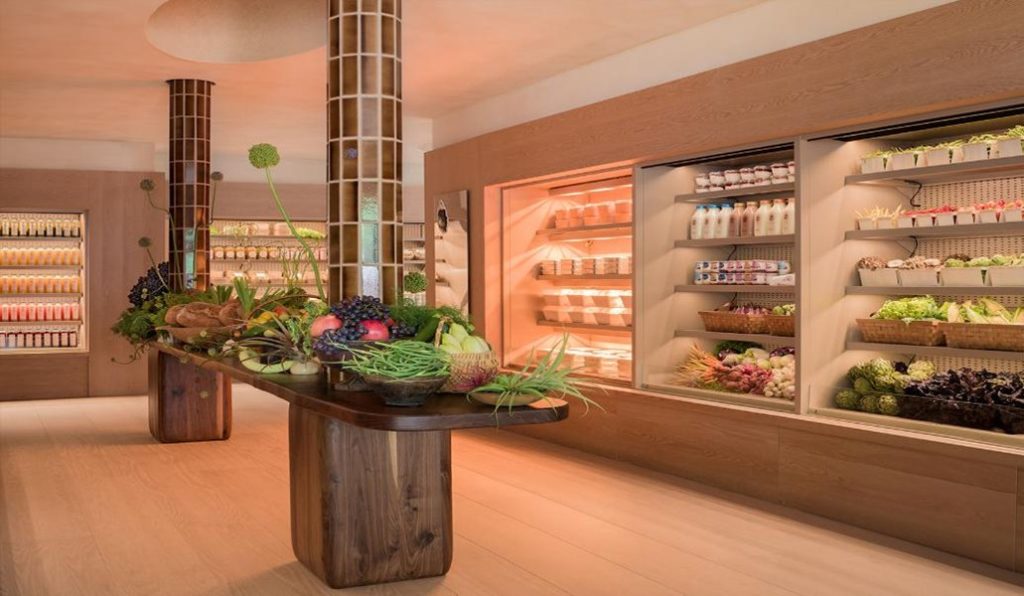
Image Source: Meadow Lane
Meadow Lane translates the Erewhon formula for Tribeca
If Laurel Supply feels like a polished West Hollywood extension of the Erewhon playbook, Meadow Lane feels like the New York version of the same idea, filtered through TikTok. The store opened in November 2025 at 355 Greenwich Street in Tribeca, about 14 months after 28-year-old founder Sammy Nussdorf posted his first TikTok captioned, “Come along to start a gourmet grocery store.” By opening day, Nussdorf had built an audience of more than 100,000 followers and 6 million likes, turning the build-out into a social-media phenomenon before the store ever made its first sale. Meadow Lane sits at about 2,300 square feet, with a tight focus on grab-and-go, prepared foods, and high-turn, high-visibility products tailored to busy, commuting New Yorkers rather than a full supermarket assortment.

Image Source: Meadow Lane
Time Out described the design as elegant, chic, and minimalistic, and the assortment spans seasonal produce, meat, dairy, prepared foods, fresh juices, pantry staples, candy, caviar, pastries, coffee, and eventually smoothies, plus an in-house floral studio. It is grocery, but filtered through the lens of convenience, curation, and aesthetics. The hero products have also helped fuel the hype, with items like $15 gluten-free chicken nuggets, $21 salads, $15 juices, and an exclusive Caffè Panna ice cream flavor all getting attention online. Beyond the premium groceries, much of Meadow Lane’s hype has been driven by social media. The store began as a story followers watched unfold in real time, helping build anticipation long before it even opened its doors. Nussdorf recently revealed on the OFFICE OF Podcast that the store is generating nearly $250,000 a week in revenue, which is a striking figure for a single self-funded location still in its first year of operation. If those weekly sales figures hold, Meadow Lane would be generating an estimated $5,652 per square foot on an annualized basis. This is more than double the $1,800 to $2,200 per square foot cited by Erewhon, already one of the most productive specialty grocers in the country. It is still early, and new store honeymoon effects are real, but the initial numbers are hard to dismiss.

Image Source: Nude Miami
Nude Miami brings the luxury grocery to Brickell
The next market to get its own Erewhon-style entrant appears to be Miami. Nude Miami, scheduled to open later this week at 1100 Brickell Bay Drive in Brickell, is being framed as a “boutique organic grocer and café” with a strong emphasis on clean ingredients, prepared foods, and social-media-ready wellness culture. The founders—Charles Amine, Harry Miller, and Sebastian Lezcano—are all in their mid-20s, and Miami Herald coverage noted that they are first-time grocers building a concept for a health-conscious South Florida customer. The store will span 4,720 square feet at the base of Panorama Tower.

Image Source: Nude Miami
The concept is heavy on foodservice and curation. Nude Miami says it will offer organic groceries, snacks, supplements, beverages, pantry staples, and non-toxic personal care, but the centerpiece is a prepared-foods program that includes what it describes as Miami’s first organic, seed-oil-free hot bar. The menu will feature proteins, sides, salads, and grab-and-go meals built around ingredients like grass-fed steak, wild-caught salmon, and pasture-raised chicken, along with a full café serving smoothies, coffee, matcha, and glass-bottled cold-pressed juices. Nude Miami is not necessarily trying to be a broad weekly grocery destination in the conventional sense. It is aiming to be a tightly edited, wellness-first, socially fluent neighborhood concept for Brickell’s trendy and well-to-do customer.

Image Source: Erewhon
Erewhon’s delivery-only smoothie move in New York
Erewhon itself has not opened a full grocery store in New York, but it did make an important move there in November 2025 by launching its smoothies as a delivery-only offer through Uber Eats and Postmates from the Erewhon Tonic Bar inside Kith Ivy in the West Village. Delivery was initially limited to about a one-mile radius, but the hero product launch in New York mattered. Even without a full store, Erewhon was able to export one of its most visible and most social-media-friendly products into the Big Apple. The drinks included celebrity-adjacent favorites like Strawberry Glaze Skin, Malibu Mango, and Coconut Cloud, and New York news coverage pegged the smoothies at about $24 each.

Image Source: Erewhon
For Erewhon, smoothies are more than just a popular menu item. They are a meaningful, celebrity-fueled business that has helped extend the grocer’s reach and recognition far beyond Los Angeles. Fast Company reported that Erewhon made $10.6 million from its Hailey Bieber smoothie collaboration after launching it in 2022, or roughly $40,000 per store per month. That helps explain why smoothie bars and tonics have become such a common thread in luxury grocery. They are photogenic, high-margin, highly shareable, and easier to turn into a routine indulgence than a jar of almond butter.
Luxury grocery as lifestyle retail
What these concepts are really selling extends well beyond premium food. They reflect the broader gentrification of grocery into highly aesthetic, aspirational lifestyle retail. Organic produce is part of the draw, but so is the atmosphere, the point of view, and the set of identity signals that extend well beyond dinner ingredients. Pantry staples now get merchandised more like beauty products, and part of that shift is being fueled by a new generation of food brands designed to look as good on a countertop or Instagram feed as they do on a shelf. Brands like Graza, Fishwife, Brightland, Fly By Jing, Flamingo Estate, and Ghia have helped turn everyday staples into aesthetic, giftable, go-viral products, further blurring the line between grocery, branding, and lifestyle. Grocery shopping becomes less of a routine errand and more of an aspirational outing.
For many younger consumers, homeownership and other traditional markers of adulthood feel increasingly out of reach. A luxury grocery haul, a branded smoothie, or a beautifully merchandised prepared food lunch is a far smaller indulgence, but it still delivers social visibility and the feeling of participating in a certain aspirational lifestyle. That does not mean these concepts are for everyone, or that they can scale cleanly, if at all. But it does help explain why this format keeps spreading. Luxury grocery is becoming less about grocery alone and more about food as identity, fashion, and wellness.
How are you thinking about new retail concepts, differentiated assortments, and the role of foodservice in your customer experience? McMillanDoolittle helps retailers and brands develop concepts, formats, and strategies built for where consumer behavior is headed. Contact us to learn more.

No Comments