


What Amazon’s Latest Updates Say About Its Grocery and Delivery Strategy
Amazon has been particularly busy over the last several months, and while the announcements span grocery, physical retail, delivery, and logistics, they point in a fairly consistent direction. The company is continuing to build around what it does best: fast delivery, supply-chain scale, and a growing focus on fresh food and everyday essentials. A few of the recent updates are worth watching.
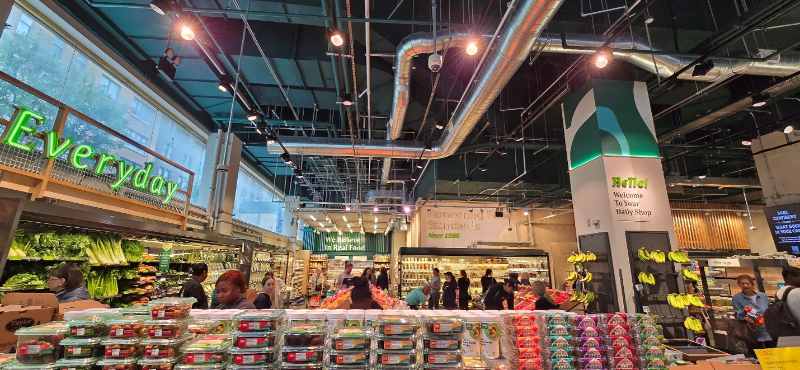
Image Source: McMillanDoolittle
- Whole Foods Daily Shop in expansion mode
Amazon’s decision earlier this year to close its physical Amazon Fresh and Amazon Go stores made it clear which brick-and-mortar banner it wants to scale: Whole Foods Market. As part of that broader shift, Amazon said it plans to open more than 100 new Whole Foods Market stores over the next few years. The company also announced signed leases for Daily Shop locations in Boston, Chicago, and Philadelphia, continuing the format’s push into dense urban neighborhoods.
That matters because Daily Shop gives Whole Foods a more flexible format for densely populated cities that may not support a full-size supermarket. It is a practical way for Amazon to keep growing physical grocery using a banner that already has brand equity, while also leaning into a smaller footprint that fits how many urban shoppers actually shop.

Image Source: Amazon
- The newest generation Dash Cart rolls out
Earlier this year, Amazon rolled out the newest generation of Dash Cart, with plans to expand it to dozens of additional Whole Foods Market locations by the end of 2026. The updated cart is 25% lighter, offers 40% more capacity, adds more payment options, includes a built-in produce scale, and reflects improvements driven by direct customer feedback. The company also noted that the latest version had already powered thousands of shopping trips, with more than 9 out of 10 customers saying they were satisfied with the experience.
What is notable here is less the cart itself than what it says about Amazon’s operating style. Dash Cart was introduced during the Amazon Fresh era, but instead of disappearing with that store format, it has been consistently refined and redeployed inside Whole Foods. That is classic Amazon: test aggressively, keep what has value, and move the useful pieces into parts of the ecosystem with better long-term fit.

Image Source: Amazon
- Amazon Now pushes convenience down to 30 minutes
Amazon also launched Amazon Now, a new ultra-fast delivery service offering thousands of groceries and household essentials in 30 minutes or less at a fee of $3.99 per order for Prime members. The service is already widely available in Atlanta, Dallas–Fort Worth, Philadelphia, and Seattle, with expansion underway in dozens of additional cities including Austin, Houston, Minneapolis, Orlando, Phoenix, Denver, and Oklahoma City. Amazon says the service is available to millions of customers today and is expected to reach tens of millions by the end of the year.
This is Amazon leaning into perhaps its clearest differentiator: logistics. Plenty of retailers can sell everyday essentials. Far fewer can move thousands of them in 30 minutes at scale, which the graveyard of ultra-fast delivery startups like Gorillas, Fridge No More, and Jokr makes clear. That is the type of convenience play that raises the bar not just for grocers, but for anyone competing on immediacy.

Image Source: Amazon
- Amazon Business extends perishables offering to workplaces
Amazon Business also added Same-Day Delivery of fresh groceries to business customers in more than 2,300 U.S. cities and towns. Business customers can now order produce, dairy, baked goods, frozen foods, and pantry staples alongside office supplies, cleaning products, and breakroom basics in one cart. Amazon says the launch is a response to one of Amazon Business customers’ top requests, and Business Prime members get free same-day grocery delivery on orders over $25 in most areas. Amazon Business now serves more than 8 million organizations globally, including 97 of the Fortune 100.
This one is easy to overlook, but it is actually pretty telling. Not only is Amazon leveraging grocery to serve households, but it is also broadening fresh and perishables into adjacent demand pockets where its delivery network already has an advantage. The practical benefit for customers is speed and simplification. The strategic benefit for Amazon is pulling even more demand through the same fulfillment infrastructure.

Image Source: Amazon
- Offering logistics capabilities more directly to businesses
The company also introduced Amazon Supply Chain Services, opening its freight, distribution, fulfillment, and parcel-shipping capabilities to businesses of all types and sizes, not just Amazon sellers. Amazon says the service builds on logistics infrastructure that has already been used by hundreds of thousands of sellers to move, store, and deliver hundreds of millions of packages through Amazon’s fulfillment network. Brands including Procter & Gamble, 3M, Lands’ End, and American Eagle Outfitters are among the early adopters.
This announcement is not as directly tied to grocery, but it reinforces the same broader point: Amazon is increasingly monetizing the infrastructure it built for itself. As tariff pressures push brands to rethink sourcing and distribution, Amazon’s offer of a ready-built, tech-enabled logistics network becomes a more compelling proposition. Just as AWS turned internal tech capability into an external business, Amazon is now trying to do something similar with supply chain and logistics.
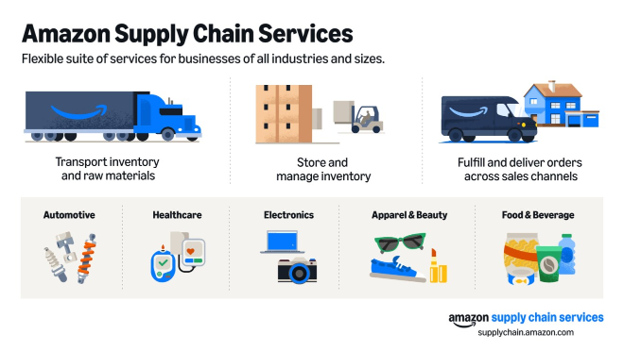
Image Source: Amazon
The Bigger Picture
Taken together, these updates suggest Amazon is becoming more focused, not less ambitious. On the retail side, that means leaning harder into fresh food, perishables, and everyday essentials, while using Whole Foods as the primary vehicle for brick-and-mortar grocery growth. On the operating side, it means continuing to widen the moat around the company’s strongest capabilities: fast delivery, logistics density, and supply-chain scale. Amazon is continuing to build around the parts of the model where it is genuinely differentiated and then extending those strengths into adjacent use cases, whether that is small-format grocery, ultra-fast household delivery, business fresh delivery, or third-party logistics.
How are you thinking about strengthening your own competitive position? McMillanDoolittle helps retailers and brands rethink growth strategy, concept development, and customer experience for the next phase of commerce. Contact us to learn more.

No Comments