

From Retailer to Media Platform: How Walmart Connect Is Redefining the Economics of Commerce
Walmart has been rewriting the economics of its business. In Q4 FY2026, Walmart disclosed that advertising and membership income together accounted for roughly one‑third of operating profit, a striking figure for a company historically defined by low‑margin retail. Walmart’s global advertising business generated nearly $6.4 billion in FY2026, less than 1% of total company revenue, but, combined with membership fees, contributed a disproportionately large share of operating income.
For decades, Walmart has been synonymous with scale, efficiency, and everyday low prices. Today, Walmart has evolved from a traditional merchant into an integrated commerce and media platform. At the center of this shift is Walmart Connect, the company’s retail media arm, which is reshaping how brands reach customers and how Walmart generates profit. Far from being a side business, Walmart Connect is one of the most important engines behind Walmart’s changing profit mix.
From retailer to platform
Walmart Connect is more than an advertising line of business. Connect is the infrastructure that connects brands, customers, data, and transactions across Walmart’s vast ecosystem. That ecosystem spans eCommerce, physical stores, marketplace sellers, and offsite channels like connected TV and programmatic media. Rather than simply selling products, Walmart is increasingly monetizing attention and data, turning every customer interaction into a measurable media opportunity.
This represents a fundamental shift in what a retailer can be. Walmart is leveraging its physical footprint, digital scale, and first‑party data to behave more like a platform than a traditional merchant. For brands, that means media and commerce are no longer separate functions. They are part of the same system, powered by the same data, optimized against the same outcomes.
The rise of retail media is a response to structural shifts in advertising and commerce. Brands are under pressure to reach more consumers while proving the return on every dollar, and traditional digital platforms, while powerful on reach, struggle to reliably tie ad exposure to actual purchases, especially in brick‑and‑mortar environments. Privacy changes and signal loss across the open web have only amplified this challenge.
Walmart is uniquely positioned to solve this problem. With millions of weekly shoppers, thousands of stores, and a scaled online marketplace, it owns closed‑loop data that connects what customers see to what they ultimately buy, both online and in store. That closed‑loop capability is what turns Walmart Connect from “just another media channel” into a strategic performance engine for brands.
Full‑funnel capabilities, online and off
What distinguishes Walmart Connect is its ability to integrate digital and physical commerce at scale—and to measure the impact of media across that full journey. Ads do not stop at driving clicks; they drive real‑world purchases in stores, with attribution that connects the dots.
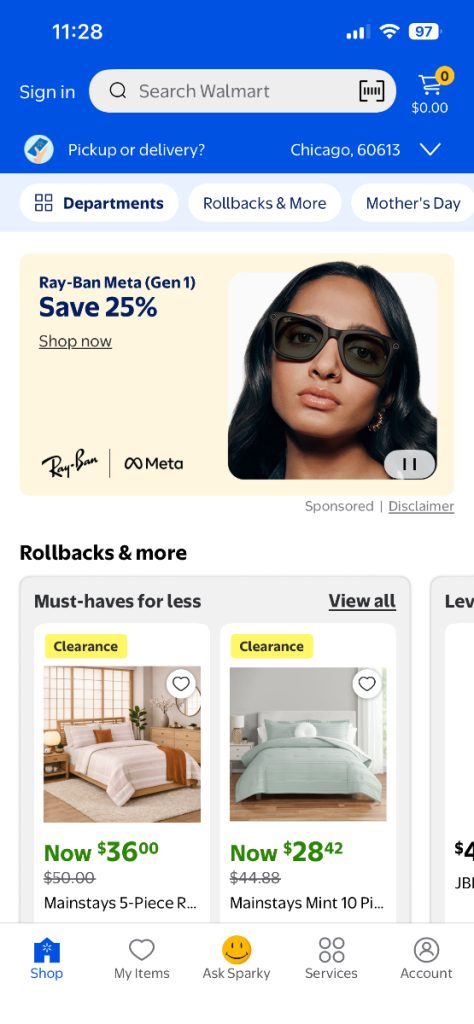
Image Source: Walmart.com
Across the funnel, Walmart Connect brings together:
- Search ads that capture demand at the point of purchase, when shoppers are actively looking for products.
- Display units and brand pages that drive mid‑funnel consideration and help brands merchandise their story within the Walmart environment.
- Offsite media, including connected TV via VIZIO and programmatic channels, that builds upper‑funnel awareness while still feeding into Walmart’s measurement stack.
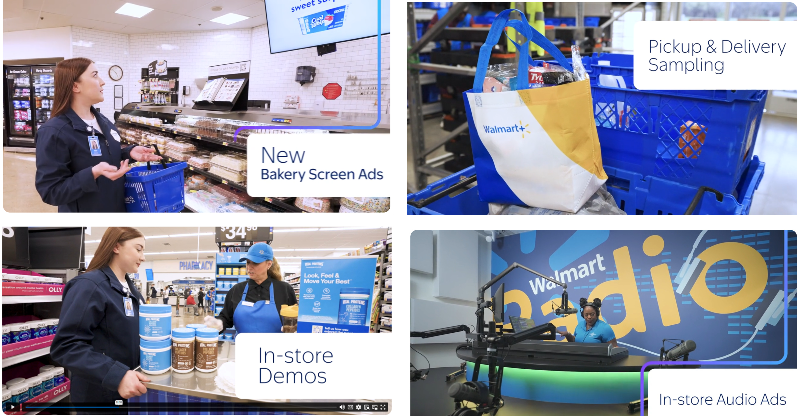
- In‑store media (digital screens, end‑caps, and other touchpoints) that influence decisions right at the shelf.
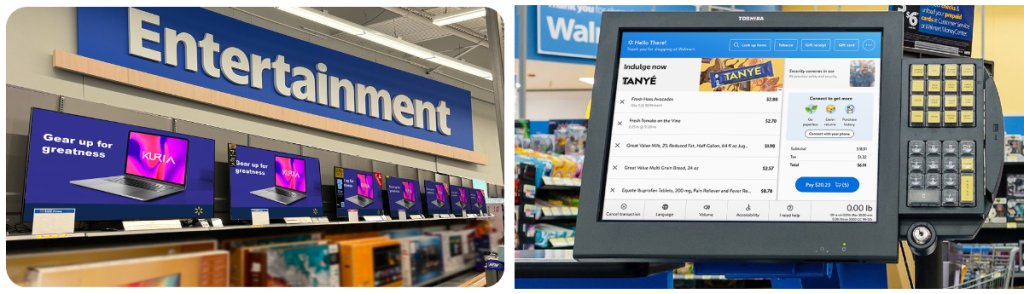
Image Source: Walmart
All of this is supported by a measurement and insights layer, including Walmart Data Ventures, that ties impressions to outcomes. For brands, the promise is simple: a clearer line of sight from media investment to sales impact, across channels.
A new profit engine
As noted earlier, while advertising may represent less than 1% of Walmart’s total revenue, it has an outsized impact on profitability. Walmart’s global advertising business generated nearly $6.4 billion in FY2026 and grew about 46% year over year, aided by the integration of VIZIO’s connected TV ad platform. In the most recent quarter, Walmart’s U.S. retail media business grew over 40% year over year, and VIZIO’s ad sales grew at a triple‑digit rate.

Image Source: Walmart
When combined with membership income from Walmart+, these high‑margin streams now account for roughly one‑third of Walmart’s operating profit. That is a critical signal for the industry: the future of retail profitability may depend less on selling more units and more on monetizing the ecosystem around those units. Retailers that can convert their traffic, data, and relationships into scalable media and membership businesses will have a structural advantage in earnings power.
Building the Walmart flywheel
Walmart Connect does not operate in isolation; it sits at the center of a broader platform strategy. Each component of Walmart’s ecosystem reinforces the others, creating a flywheel for growth and profitability.
- Marketplace growth brings more third‑party sellers onto the platform. Those sellers not only expand assortment and drive GMV, but also become natural advertisers seeking visibility within Walmart’s ecosystem.
- Walmart Data Ventures monetizes Walmart’s first‑party data by providing advanced analytics and insights to brands and advertisers, improving campaign performance and informing broader commercial decisions.
- Walmart+ deepens customer engagement, increases frequency, and enriches first‑party data signals, which in turn enhances targeting and measurement capabilities for Walmart Connect.
- The VIZIO acquisition adds a scaled smart TV operating system and connected TV inventory, extending Walmart’s media presence into the living room and significantly expanding high‑margin ad inventory.
The logic of the flywheel is straightforward: more customer and media data enable better targeting and personalization, which drive stronger campaign results. Stronger results justify more ad spend, which generates more revenue and profit that Walmart can reinvest into technology, data, and customer experience. The cycle is accelerated.
Competing on a different field
As Walmart Connect scales, Walmart is no longer competing only with other retailers. It is increasingly competing for ad budgets that once went almost exclusively to Amazon, Google, and Meta alongside other retail media networks such as Target and Instacart. The battleground is not just shelf space or eCommerce traffic. It is control over audiences, data, and measurable outcomes.
According to EMARKETER, Amazon Ads commanded 79.7% of the U.S. retail media market in 2025, while Walmart Connect ranked a distant second at 8.0%, more than five times the share of Target Roundel at 1.5%. In 2026, EMARKETER also forecasts Amazon and Walmart to capture 89% of incremental retail media spending for the year, underscoring how quickly the market is consolidating around a small number of scaled players.
Walmart’s differentiation lies in its ability to deliver omnichannel closed‑loop measurement at scale. The Walmart ecosystem offers a unique combination of national brick‑and‑mortar reach, growing online marketplace, first‑party transaction data, and a connected TV platform under one roof. For brands, that creates a distinctive value proposition: a single partner that can run integrated campaigns from awareness to conversion, with a read on incremental sales both online and in store.
On the risk side, Walmart must navigate an increasingly complex regulatory environment around privacy, data use, and consent, especially as it expands its role as a media and data platform. It must also respond to growing demand from brands for transparent, independent measurement and clear methodologies for incrementality and attribution.
Walmart will need to carefully balance monetization with customer experience. As retail becomes media, retailers risk cluttering the shopping journey with intrusive ads or eroding trust if customers perceive their data is being over‑leveraged. The retailers that win will be those that treat trust and usability as strategic assets, not afterthoughts.
Implications for retailers
For other brand driven retailers, Walmart’s evolution is not a signal to copy its scale, it is a signal to clarify competitive edge. Other retailers may not match Walmart’s reach, but they can compete on the distinctiveness of their data, the specificity of their customer missions, and the quality of their partnerships. The strategic question is “How do we turn our traffic, loyalty, and category expertise into a differentiated value proposition for brands?”
The first priority is to get your data house in order. That means investing in clean, connected first‑party data across store, eCommerce, and loyalty; establishing clear consent practices; and building at least a foundational ability to measure media against sales outcomes. For many mid-sized banners, the right answer will be to partner with retail media technology platforms, agencies, or networks rather than building every component in‑house but internal ownership of the strategy, economics, and customer experience is critical.
Second, be highly selective about where you play. Specialty retailers and regional chains often own “high‑intent” missions like weekly grocery baskets, health and wellness journeys, project‑based home improvement, or passion‑led categories like outdoor, pets, or beauty. That context is the advantage. Design media and data offerings that help brands win specifically in those missions, and align your merchandising, promotions, and content so that advertising feels like an extension of the shopping experience, not an interruption.
Finally, treat media, data, and customer experience as one integrated agenda (not separate projects owned by different teams). Set clear guardrails for how many ad placements appear in your digital experiences, how they are targeted, and how they support your brand promise. Build cross‑functional governance that brings together merchants, marketers, store operations, and IT to decide where media adds value and where it crosses the line. As Agentic AI unlocks new forms of automation such as personalized shopping agents, dynamic offers, and AI‑driven planning tools, the retailers that have clean first‑party data and a thoughtful media strategy in place will be in the best position to benefit. Those that delay risk finding that the most valuable profit pools in their own ecosystems have been captured by others.
What role should media, membership, and first-party data play in your future growth strategy? McMillanDoolittle works with retailers and brands to develop concepts, capabilities, and business models built for where commerce is headed. Contact us to learn more.

No Comments