


Key Trends from NRF 2025 Big Show: AI, RMNs, Digital Twins, ESG, and More
Key Trends from NRF 2025 Big Show: AI, RMN’s, Digital Twins, ESG, and More
Every January, the retail industry kicks off the new year by converging at the Javits Center in New York for the National Retail Federation’s Big Show to explore new solutions and understand key trends to expect in the year ahead. This year, McMillanDoolittle attended NRF and adjacent events including the What’s In Store for Retail Media Networks conference and RETHINK Retail’s AI in Retail conference.
Here are some of the key takeaways from this year’s lineup of events:
1. AI at the Center of Innovation
It should come as no surprise that AI was the central theme at this year’s Big Show. Compared to last year, when AI showed its initial promise and was still used in part as a buzzword, it has become a foundational element underpinning innovation in retail.
A key evolution discussed was agentic AI, semi-autonomous systems capable of pursuing specific objectives. Albertsons shared insights at NRF on leveraging AI tools to better forecast inventory needs and reduce waste, aligning with its broader operational goals. A key example was Target’s rollout of its “Store Companion” chatbot, mentioned in sessions for its ability to enhance team efficiency and customer experiences through GenAI-driven insights.
2. The Continued Growth of Retail Media Networks
Retail media networks (RMNs) are continuing their upward growth trajectory. This year’s discussions highlighted a vision for RMNs to move from a pure advertising play to an integral part of the shopping journey. At the What’s In Store for Retail Media event, RMN leaders from Costco, Walgreens, CVS, Carrefour, Albertsons, and other retailers discussed recent successes as well as the challenges that must be overcome to realize the benefits of this significant growth opportunity. Among these challenges, retailers noted opportunities to improve collaboration with partners, increase consumer-centric focus, and develop new organizational capabilities. All of these will be critical to fully unlocking the potential of RMNs in shaping the future of retail.
3. Digital Twins in Action
The concept of digital twins, virtual replicas of physical environments, gained more traction as new use cases emerged. From optimizing store layouts to monitoring supply chain sustainability, this technology is enabling retailers to visualize and test changes in a risk-free, virtual setting before making real-world adjustments. While the concept of a digital twin isn’t new—Lowe’s implemented its store digital twin in 2022 to simulate operational changes—the technology continues to evolve, unlocking new possibilities for retailers. NVIDIA’s advancements in digital twins exemplify this evolution, showcasing innovations in predictive modeling, real-time supply chain visualization, and operational efficiency. NVIDIA showcased its new Omniverse platform, demonstrating how digital twin technology is transforming operations for companies like supply chain logistics firm KION by providing predictive insights and streamlining logistics.
4. Sustainability Returns to the Forefront
Sustainability continues to be a pressing focus for retailers, driven by the dual pressures of meeting their own ambitious 2030 sustainability targets and responding to rising consumer demand for responsible practices. Walmart’s Head of Corporate Sustainability, Jerome Del Porto, shared how the company is integrating circular business models, such as recycling expired products into biofuel and livestock feed through partnerships like Denali Food Waste Solutions. Tools like o9’s supply chain software enable brands to assess environmental footprints while streamlining operations. PepsiCo’s deployment of o9’s tools to track environmental impacts across its product lifecycle was highlighted as an industry-leading approach to aligning sustainability with profitability.
5. Innovation in Immersive Shopping Experiences
Virtual try-ons, augmented reality-enabled store navigation, and immersive product visualization tools featured prominently on the showroom floor. Featured in NRF’s Innovators Showcase, companies like Curated For You demonstrated AI-powered personalized shopping platforms, creating tailored recommendations for individual customers, while PulpoAR showcased cutting-edge AR tools for virtual try-ons and product visualization, enhancing the digital and in-store shopping experience. These innovations highlight how retailers are leveraging immersive technologies to engage customers in new and meaningful ways.
6. Workforce Enablement through Technology
Technology is transforming workforce management, not by replacing employees but by empowering them. AI-driven scheduling tools, task management systems, and operational insights are helping retailers optimize labor while enabling associates to focus on delivering exceptional customer service. At NRF, solutions like Reflexis Systems’ AI-powered task management software were showcased, emphasizing their ability to help associates prioritize tasks in real time and improve in-store productivity. These technologies reflect how retailers are focusing on empowering their workforce through precision and automation, illustrating the industry’s commitment to leveraging technology not just for efficiency, but for creating a more empowered and engaged workforce.
7. Video Analytics and Computer Vision for Operational Excellence
Advancements in video analytics and computer vision are enhancing retail operations in areas such as loss prevention, inventory management, and payment solutions. PopID’s facial payment system, featured at the JP Morgan booth, and Walmart’s integration of video AI into its stores are helping retailers increase efficiency and security. Additionally, ZeusAI, highlighted in the Innovator Showcase, demonstrated its ability to deliver precise customer traffic predictions and optimize product placement through advanced AI-powered heat mapping.
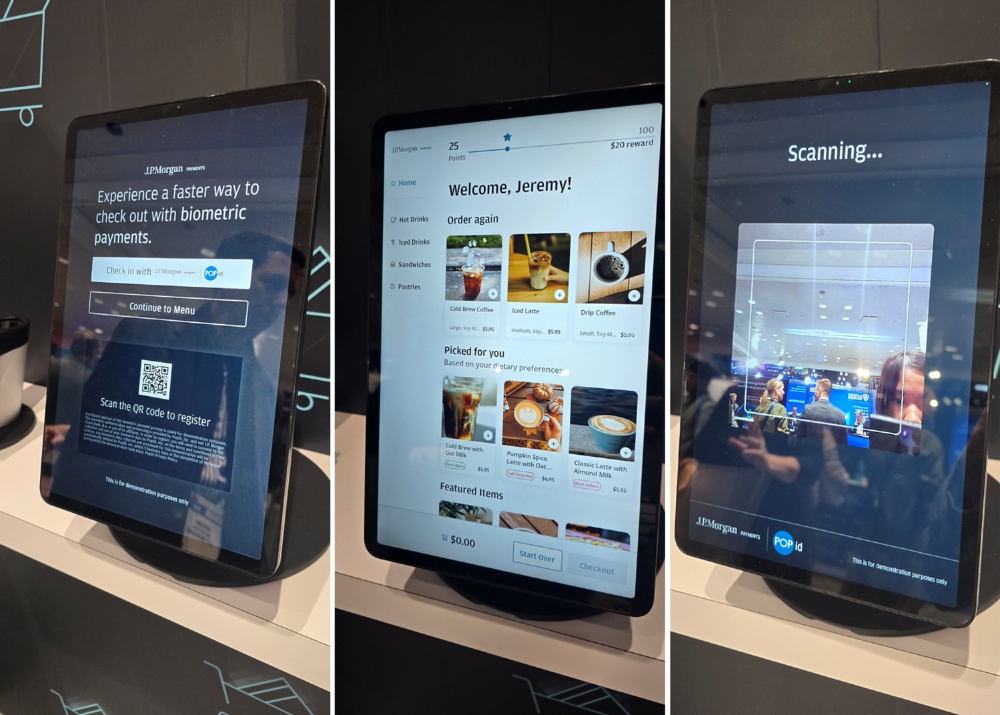
Photo Credit: McMillanDoolittle, PopID’s biometric facial payment solution in partnership with J.P. Morgan.
Applying This Year’s Takeaways to Your Business
The NRF 2025 Big Show underscored the transformative role of technology in retail. AI is no longer a futuristic concept but a tangible tool reshaping operations, customer engagement, and sustainability efforts. Unified commerce and immersive technologies are redefining how customers experience retail, while digital twins and video analytics are enabling smarter operational decisions.
This past year, McMillanDoolittle launched our Generative AI Transformation Immersion Offering, designed to help retailers and brands unlock the potential of GenAI for their businesses. In collaboration with Mary Purk, former Managing Director of The Wharton School AI & Analytics Initiative, we offer half-day to full-day sessions for executive teams, providing actionable insights and strategies for:
- Driving traffic, enhancing the shopper experience, and increasing conversions
- Streamlining and optimizing operations with GenAI applications
- Defining and prioritizing business cases for immediate AI investments
- Embedding ethics into AI implementation and governance
Inspired by this year’s Big Show? Contact us to discuss how these trends and our new GenAI offering can shape your strategy for 2025 and beyond.

No Comments