


Walmart’s Big AI Bet and What Might Change Under New CEO John Furner
Walmart isn’t dabbling in AI, it’s betting big. With Doug McMillon stepping down and John Furner taking the reins in February 2026, the world’s largest retailer is doubling down on technology as the engine of its next chapter. Here’s what Walmart has already built, and where things might accelerate under Furner’s watch.
Walmart has made one thing clear: AI isn’t a side project. It’s becoming the backbone of how the company operates, from the way customers shop to how stores and supply chains move products.
That matters because Walmart is about to change leadership. Doug McMillon will retire on January 31, 2026, and John Furner, currently CEO of Walmart U.S., will step into the role of President and CEO of Walmart Inc. on February 1, 2026. The board has called this a transition into an era “fueled by innovation and AI.” In other words, the direction is already set.
So the real question isn’t “Will Walmart use AI?”, it’s “Where will Walmart push hardest next, and what will speed up or tighten under Furner?”

Image Source: Walmart
AI Is Built In, Not Bolted On
Walmart’s approach to AI is practical. It’s about tools that make real retail work easier, not just flashy demos.
- For employees: Walmart introduced My Assistant, a generative AI tool that helps with drafting, summarizing, and brainstorming. It started with corporate teams in 2023 and has expanded since then. The goal is simple: cut down on busywork and free people up for higher-value tasks.
- Retail-specific AI: Walmart has developed models like Wallaby, tuned to its own retail data. Retail isn’t generic, its catalogs, substitutions, seasonality, and inventory quirks. A model that understands those realities should perform better than a general chatbot.
- Beyond single tools: Walmart is building an AI framework with multiple “super agents,” including Sparky for customers, Marty for merchants, and others for associates and developers. The idea is to create reusable capabilities that scale across the company.
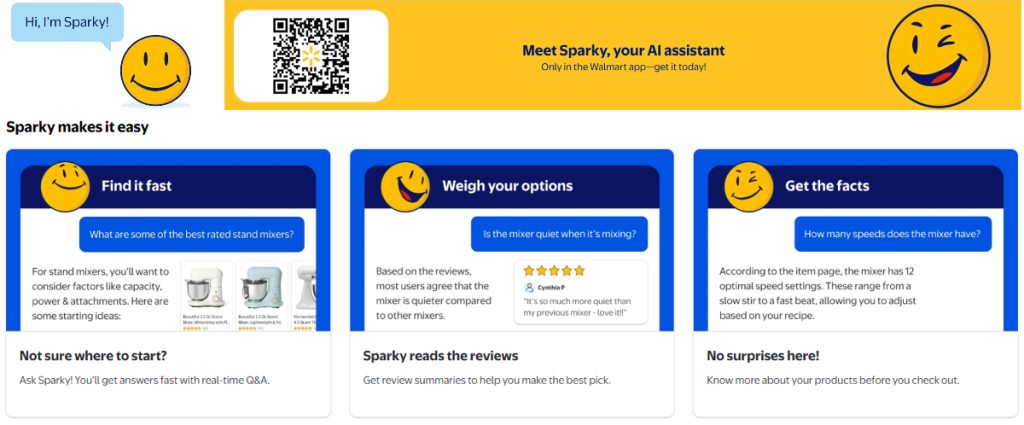
Image Source: Walmart
For Customers: From Search to “Help Me Do It”
The most visible AI feature for customers is Sparky, the shopping assistant in the Walmart app. Walmart has hinted that Sparky will evolve from answering questions to actually completing tasks. That’s the difference between a nice feature and a new way to shop.
This shift has been coming for a while:
- AI-powered search lets shoppers describe what they want, like planning a party, instead of typing item-by-item.
- Walmart has tested “replenishment” features that build carts based on past purchases, with customers approving the final list.
- In October 2025, Walmart announced a partnership with OpenAI to enable purchases through ChatGPT using “Instant Checkout.” It’s not fully live yet, but it shows Walmart wants to meet customers wherever they are, not just in its own app.

Image Source: Walmart
Where the Big Wins Are: Supply Chain and Fulfillment
The biggest payoff from AI isn’t in chatbots. It’s in operations—reducing costs and improving availability.
- Walmart expanded its relationship with Symbotic in 2025, investing $520 million in AI-driven automation for pickup and delivery centers, with plans for 400 deployments.
- The company is also investing in sensor-enabled tracking for better visibility of items and pallets. This matters because if your inventory data is wrong, everything else—recommendations, substitutions, customer experience—falls apart. Data quality is strategy.
What to Expect From John Furner
Don’t expect a big pivot. Walmart’s AI strategy is already moving. What will change is the pace and emphasis.
Furner has led Walmart U.S. since 2019 and knows store operations inside out. That background suggests a focus on AI that delivers measurable results: faster processes, better accuracy, higher productivity, and fewer customer headaches.
Here are three likely shifts under his leadership:
- Store-first AI becomes the priority.
Expect more focus on tools that improve inventory accuracy, shelf availability, pickup and delivery, and those that drive customer transactions. These changes compound across thousands of stores. - A quicker move from assistant to agent, with strict guardrails.
Walmart will likely accelerate automation for tasks like replenishment, substitutions, returns, and customer care. But expect tight controls to avoid errors—because mistakes in retail create real-world problems. - More discipline in building platforms.
If Wallaby and other internal AI platforms are strategic bets, the next step is standardizing and deploying them globally. Building once and scaling everywhere is how Walmart turns size into advantage.
The Real Challenge: Trust
The hardest part isn’t getting AI to generate answers. It’s earning trust. Wrong product claims, bad substitutions, privacy issues, or inconsistent service can damage confidence quickly. Walmart’s edge will come from connecting AI to what it already does best: store density, fulfillment capacity, and supply chain strength. If AI becomes the interface for shopping, the winners will be the ones who can deliver reliably, not just talk about it.
Under Furner, expect Walmart to keep doing what it’s started—and push harder. Less “AI as a feature,” more “AI as the way the business runs.”
What’s your AI strategy for growth? Our team helps retailers move from experimentation to execution. Contact us to learn more about our AI immersion workshops.

No Comments